 09 May, 2026
4060Views
09 May, 2026
4060Views The debate around SPC flooring vs vitrified tiles has become one of the most searched flooring questions in India in 2026. Walk through any new apartment complex in Mumbai, Bengaluru, or Hyderabad and you will find both materials side by side, each with passionate advocates. Homeowners, architects, and interior designers are asking the same question: which flooring is the smarter choice for Indian homes in a country defined by extreme summers, monsoon humidity, heavy foot traffic, and renovation budgets that need to stretch?
The honest answer is that neither is universally better. Both SPC flooring India and vitrified tiles India are strong materials with very different performance profiles. The right choice depends on your room, your climate zone, your household, and how long you plan to stay in the property. This guide breaks down every comparison point clearly so you can make a confident, informed decision.
Antovia Surfaces, based in Morbi, Gujarat, manufactures both premium SPC flooring and high-quality porcelain and vitrified tiles. That dual manufacturing perspective allows us to give you an honest comparison rather than a biased pitch.
What Is SPC Flooring?
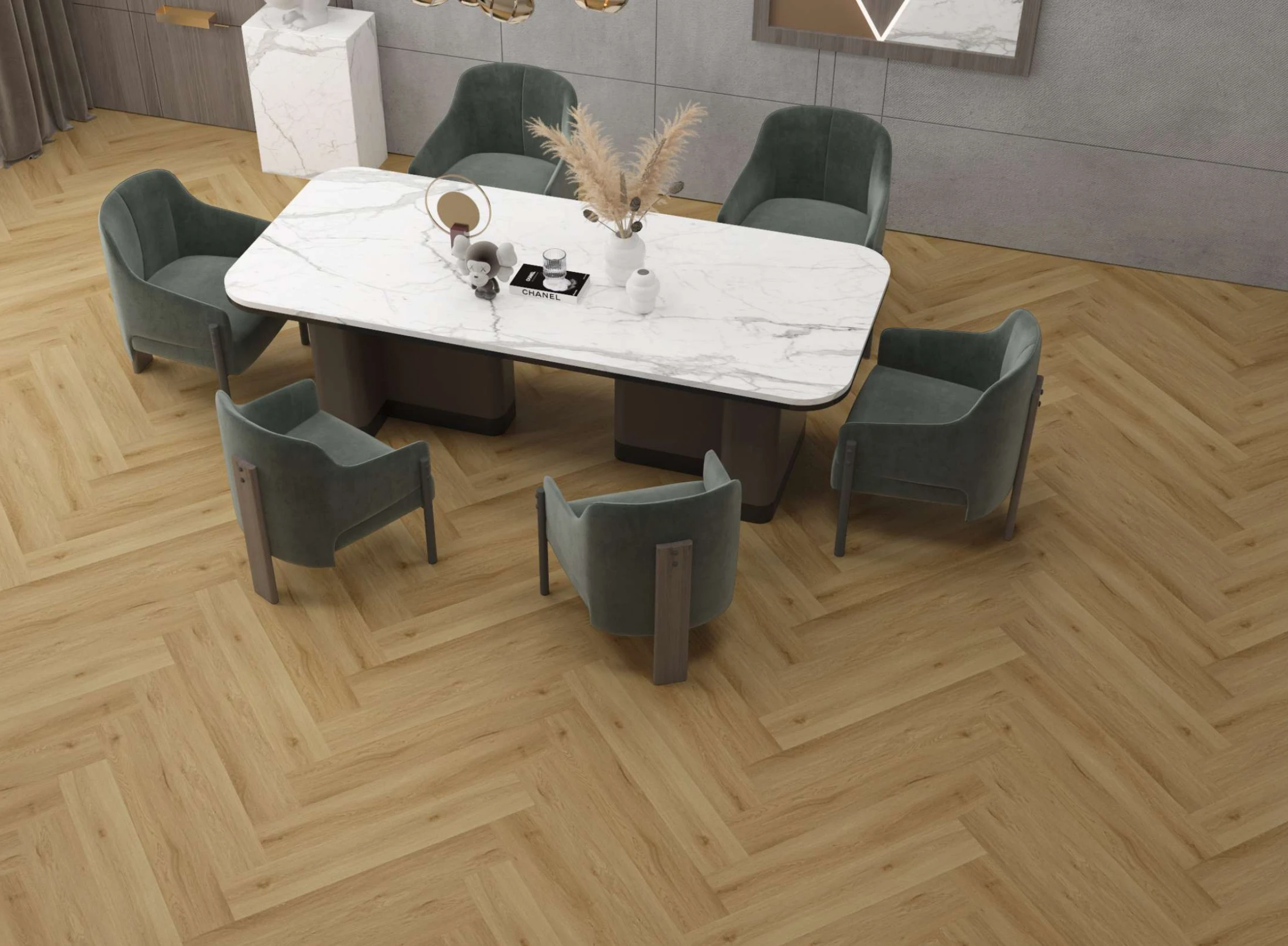
Stone plastic composite flooring (SPC) is a rigid core luxury vinyl product made from a blend of limestone powder, polyvinyl chloride (PVC), and stabilizers compressed under high heat and pressure. The result is a dense, stable core that is completely SPC flooring waterproof throughout its entire thickness, not just on the surface. A standard SPC plank has five layers: UV coating, wear layer (0.3 mm to 0.7 mm), decorative film, rigid core flooring layer, and IXPE or EVA foam backing.
The wear layer is the most important specification when buying SPC flooring India. Residential applications require at least 0.3 mm. For kitchens, hallways, and commercial spaces, a 0.5 mm or 0.7 mm wear layer is recommended. The decorative film uses high-definition digital printing to replicate wood, marble, stone, or abstract patterns with extremely realistic results.
SPC click lock flooring is installed as a floating floor using a click-and-lock joint system. No adhesive, no nails, and no demolition of existing floors is required. A standard 1,000 square foot apartment can be fully floored with SPC in one to two days.
What Are Vitrified Tiles?
Vitrified tiles India are ceramic tiles that have been vitrified during manufacturing, meaning silica and other minerals are heated to extremely high temperatures to create a glass-like, non-porous surface. This process gives vitrified tiles their signature hardness, low water absorption below 0.5 percent, and high resistance to staining and abrasion.
Glazed vitrified tiles have an additional layer of glaze applied before firing, which enables the full range of finishes available today including high-gloss, matt, satin, carving, wood-look, and marble-look designs. Porcelain vitrified tiles represent the premium end of the category, with higher density, lower water absorption, and better long-term surface durability.
Vitrified tiles remain the most widely used flooring for Indian climate conditions because of their thermal stability, extreme hardness, and long proven track record in Indian residential and commercial construction. They are available in sizes from 300 x 300 mm up to 1200 x 2400 mm large-format slabs.
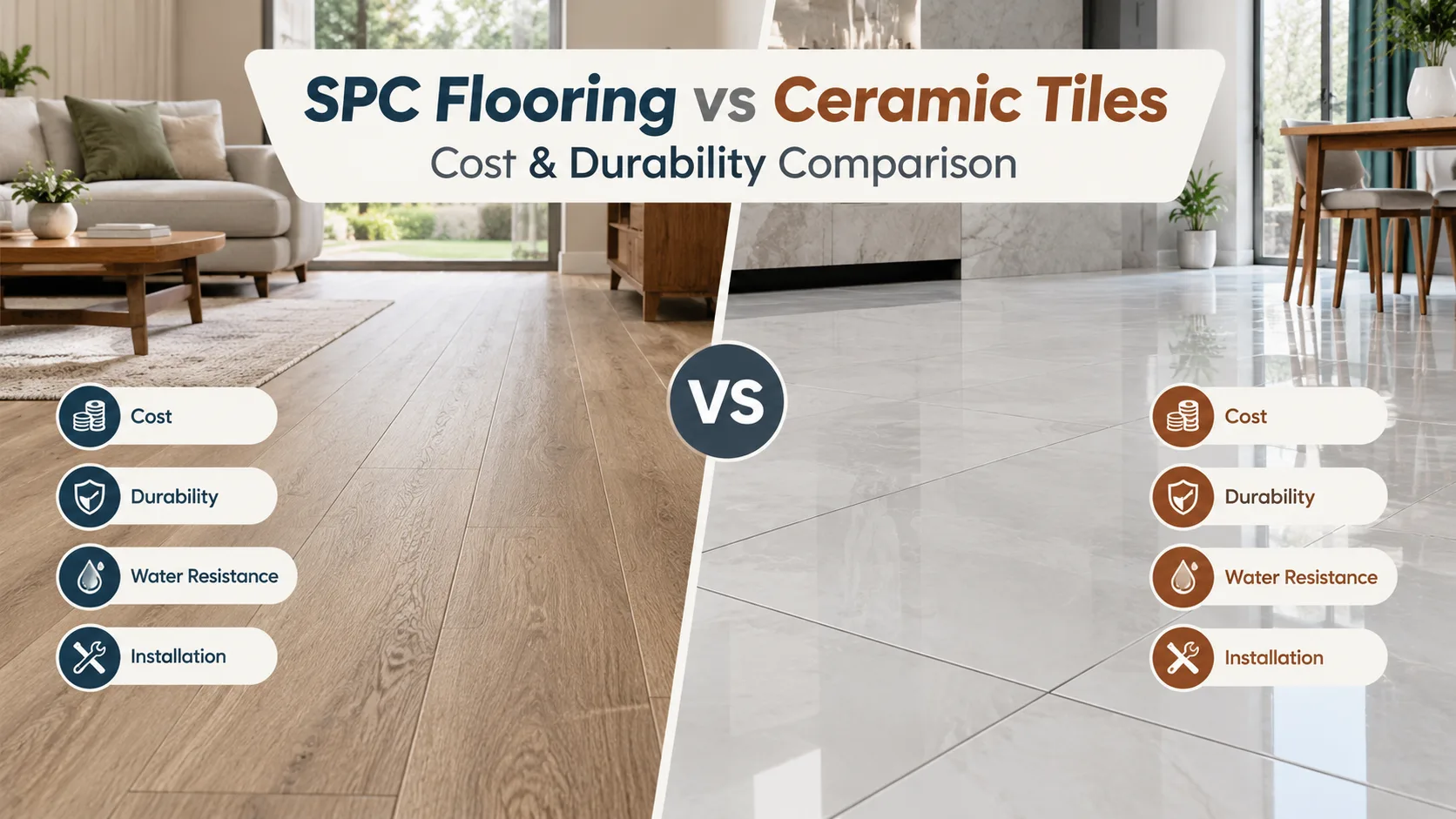
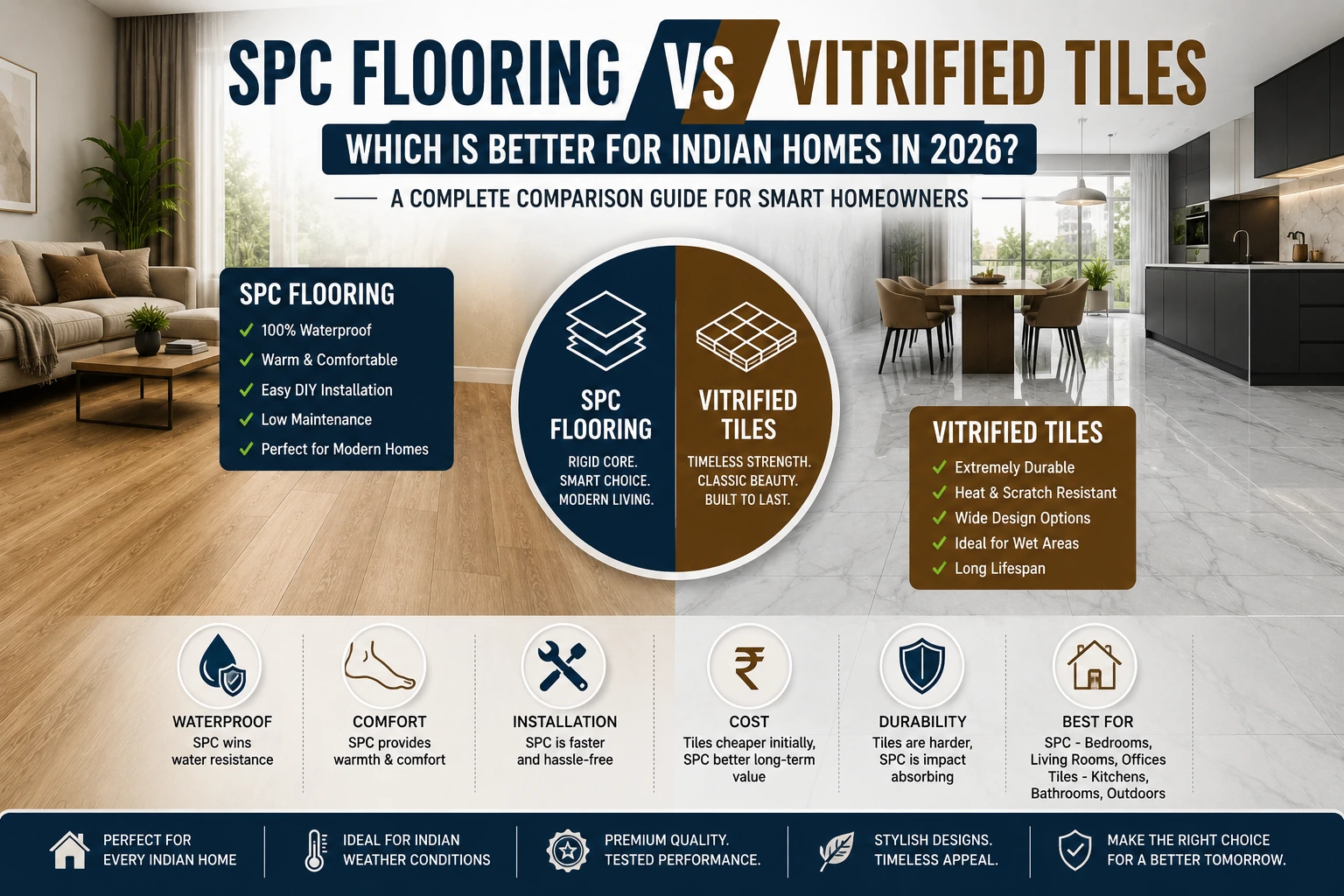
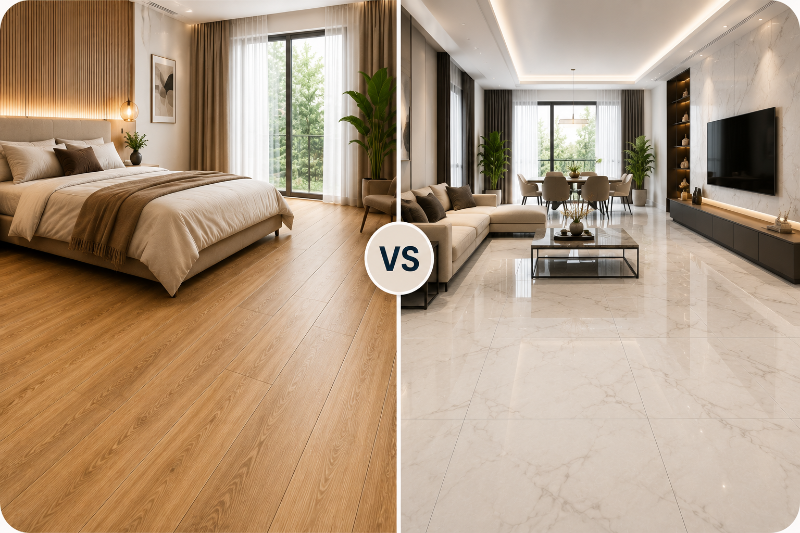
SPC Flooring vs Vitrified Tiles: Head-to-Head Comparison
The table below compares both materials across every factor that matters for Indian homeowners in 2026.
| Factor | SPC Flooring | Vitrified Tiles |
| Waterproof | 100% waterproof throughout | Water resistant,not fully waterproof |
| Hardness | Dense rigid core, impact absorbing | Extremely hard but chips on impact |
| Comfort underfoot | Warm, cushioned, quiet | Cold and hard, echo underfoot |
| Installation | DIY click-lock, 1-2 days, no demo | Adhesive + grout, 3-5 days, professional |
| Price (materials) | Rs 85-260 per sq ft | Rs 35-250 per sq ft |
| Installation cost | Rs 20-40 per sq ft | Rs 60-120 per sq ft |
| Total cost | Rs 110-300 per sq ft installed | Rs 100-370 per sq ft installed |
| Lifespan | 15-25 years with care | 20-40 years |
| Maintenance | Sweep and mop, no grout | Sweep and mop, grout upkeep needed |
| Indian climate | Stable from -5 to 60 degrees C | Stable but cold in winters |
| Best rooms | Bedroom, living room, office | Kitchen, bathroom, outdoor, living room |
| Design range | Wood, marble, stone, abstract | Endless with digital printing |
| Over existing floor | Yes, over flat tiles or wood | No, old floor must be removed |
| Repair | Individual plank replacement | Crack/chip requires professional rework |
Detailed Comparison: Which Wins in Each Category?
1. Waterproofing and Moisture Performance
SPC flooring waterproof performance is total. The stone-plastic composite core does not absorb water at any level, making it the definitive choice for waterproof flooring India applications including bathrooms, kitchens, laundry areas, and balconies that are covered. Unlike laminate, SPC will not swell, buckle, or warp when water is spilled on it or when the subfloor has residual moisture.
Vitrified tiles India are water resistant with below 0.5 percent water absorption, making them highly practical for wet areas. However, the grout lines between tiles are the weak point. Grout absorbs moisture over time, becomes a breeding ground for mold and mildew, and stains permanently in kitchens and bathrooms if not sealed every year or two. For truly wet spaces, SPC flooring bathroom installations are easier to maintain long-term because there are no grout lines.
Verdict: SPC wins on waterproofing. Vitrified tiles win on water resistance for outdoor and heavy-wet applications.
2. Durability and Lifespan
SPC flooring lifespan ranges from 15 to 25 years depending on wear layer thickness and foot traffic. The 0.5 mm to 0.7 mm wear layer used in premium products is highly scratch resistant and handles daily furniture movement, pet claws, and high heel marks without visible damage. However, if a heavy object falls directly onto SPC, it can dent or crack the plank, which can then be individually replaced.
Glazed vitrified tiles are significantly harder than SPC and can last 30 to 40 years or longer when properly installed. They resist scratching, heavy furniture loads, and outdoor weather exposure. The critical weakness is brittleness: a dropped heavy object can chip or crack a tile, and replacing a single tile often means colour mismatch if the batch is discontinued.
Verdict: Vitrified tiles win on raw lifespan. SPC wins on ease of repair and individual plank replacement.
3. Comfort and Indoor Climate Performance
For best flooring for Indian homes in bedrooms and living rooms, comfort is a top priority. SPC flooring bedroom installations are popular because SPC is warmer underfoot, absorbs foot noise, and does not echo across a room the way hard tiles do. Families with young children or elderly members particularly benefit from the cushioned feel and slip-resistant texture that premium SPC provides.
Vitrified tiles India are cold in winter mornings, which is a significant comfort issue in North and Central India. They are also louder underfoot. However, in South India and coastal regions where temperatures rarely drop below 20 degrees, the thermal mass of vitrified tiles actually keeps rooms cooler during summer, which is a real advantage.
Verdict: SPC wins for comfort in cooler climates and bedrooms. Vitrified tiles win for heat management in hot climates.
4. Installation and Renovation Convenience
SPC flooring installation India is dramatically simpler than tile work. The SPC click lock flooring system requires no adhesive, no grout, no cement screed, and no curing time. A professional installer can cover 300 to 500 square feet per day. Homeowners who are reasonably handy can install SPC themselves. The most important advantage for renovation projects is that SPC can be laid directly over existing flat tiles or wood floors, completely eliminating demolition costs and the days of noise, dust, and disruption that tile removal creates.
Installing vitrified tiles India requires a professional team, adhesive mortar, grout, leveling spacers, and typically three to five days for a standard 1,000 square foot apartment, plus drying and curing time before the space can be used. Tile removal from an existing floor adds significant cost and time, typically Rs 15 to 25 per sq ft for demolition and debris disposal.
Verdict: SPC wins on installation convenience and renovation speed by a large margin.
5. Cost Comparison in India 2026
The true cost of SPC vs tiles India only becomes clear when you include installation. Mid-range SPC flooring price per sq ft India is Rs 130 to 180 per sq ft for materials, with installation at Rs 20 to 40 per sq ft, bringing total cost to Rs 150 to 220 per sq ft installed. Premium SPC with 0.5 mm wear layer and IXPE backing reaches Rs 250 to 300 per sq ft installed.
Vitrified tile price India for mid-range glazed vitrified tiles runs from Rs 35 to 100 per sq ft for materials, but vitrified tile maintenance and professional installation add Rs 60 to 120 per sq ft, bringing total cost to Rs 100 to 220 per sq ft. Premium porcelain vitrified tiles in large formats can reach Rs 300 to 400 per sq ft installed. When renovation work includes demolishing old tiles, add Rs 15 to 25 per sq ft to the vitrified tile project cost.
Verdict: SPC and vitrified tiles are comparable in total installed cost for mid-range projects. SPC saves significantly when renovating over existing floors.
6. Design and Aesthetic Options
Both materials offer an impressive design range in 2026. SPC flooring for home India shines in wood-look and stone-look patterns, with EIR (Embossed-in-Register) technology that aligns the 3D texture of the surface with the printed grain underneath, creating highly realistic results. SPC planks are available in sizes from 150 x 900 mm to 230 x 1500 mm, giving a contemporary feel to any room.
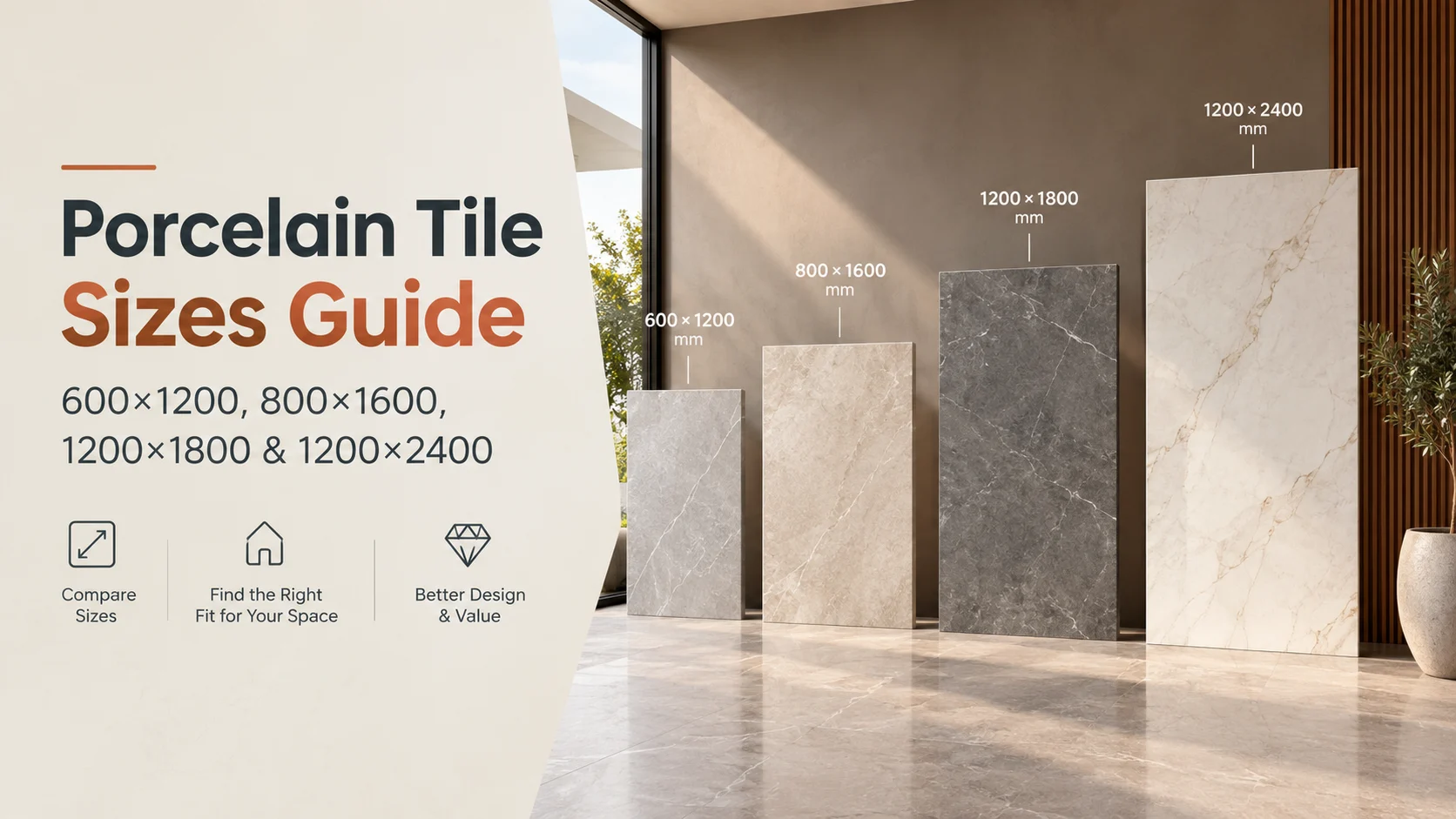
Glazed vitrified tiles offer the widest design range of any flooring material, with digital printing enabling marble-look, wood-look, terrazzo, geometric, and custom patterns in sizes from 300 x 300 mm to 1200 x 2400 mm. Large-format porcelain vitrified tiles in 800 x 1600 mm and 1200 x 2400 mm formats are the dominant interior design trend in 2026, creating seamless, grout-free-looking floors that are difficult to replicate with SPC.
Verdict: Vitrified tiles win on sheer design variety. SPC wins for wood and textile-effect aesthetics.
Room-by-Room Recommendation for Indian Homes
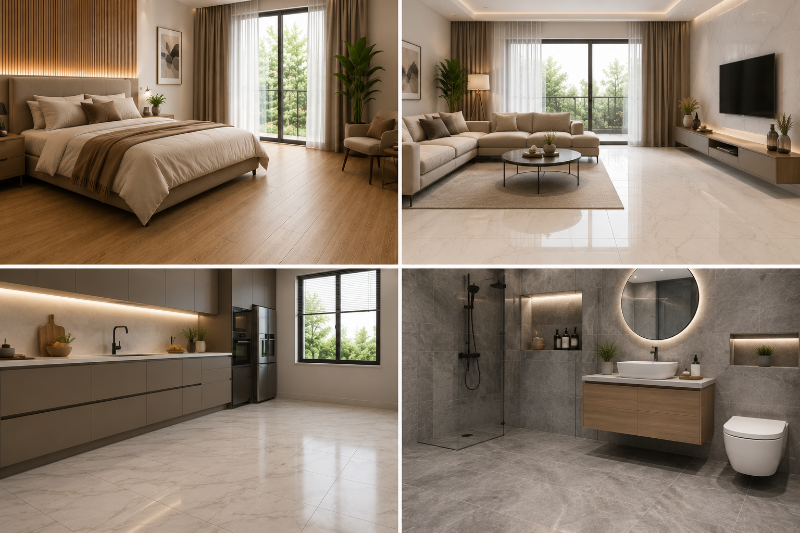
Use this guide to choose the right flooring for each space in your home.
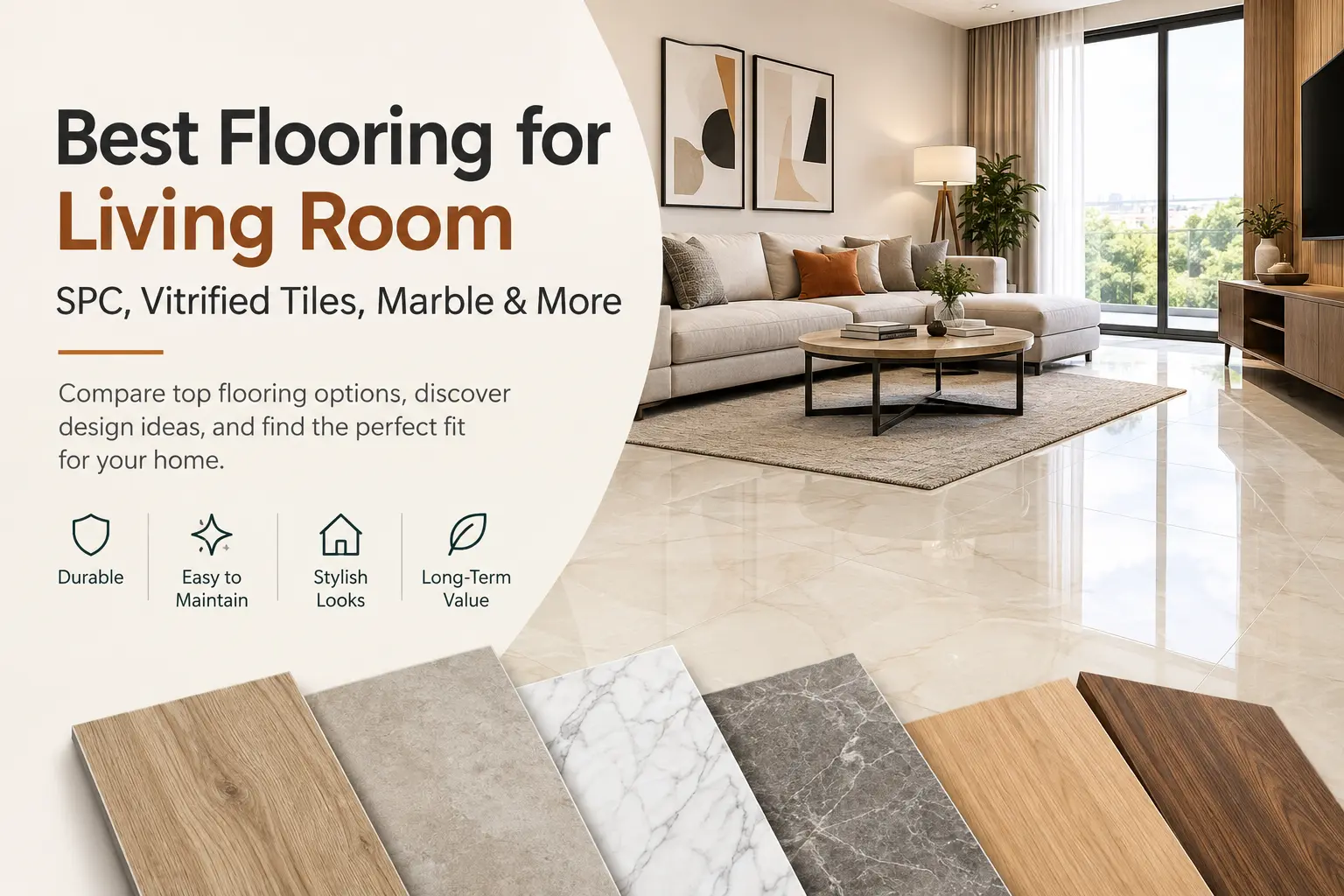
• Living room: Both work well. SPC is warmer and quieter. Large-format glazed vitrified tiles (800x1600 mm) create a premium look with fewer grout lines. Choose based on your aesthetic preference.
• Bedroom: SPC flooring is strongly preferred. The warmth underfoot, sound absorption, and comfort of SPC flooring bedroom installations make a genuine daily-life difference, especially during winter mornings.
• Kitchen: Both are suitable. SPC flooring kitchen India installations are growing rapidly because of the waterproof core and easy installation over existing kitchen tiles. Anti-skid vitrified tiles remain the traditional choice for heavy kitchen use.
• Bathroom: SPC flooring bathroom installations work well in dry-wet separation bathrooms. For fully wet bathrooms with constant standing water, anti-skid flooring India vitrified tiles are more reliable as they handle subfloor moisture better.
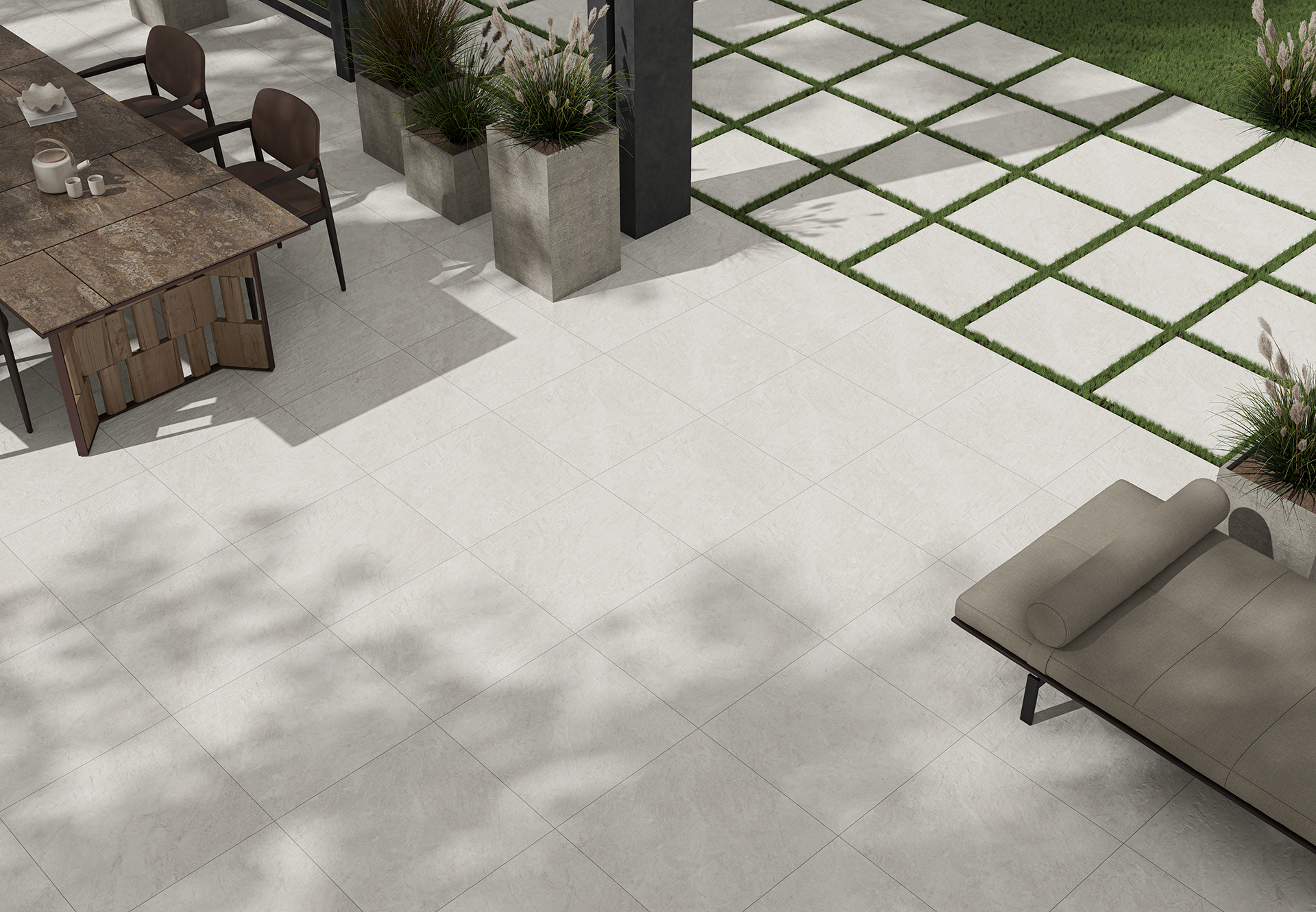
• Balcony or outdoor area: Vitrified tiles only. SPC is not rated for continuous outdoor sun and rain exposure. Full-body vitrified or outdoor-grade porcelain tiles are the correct specification for balconies, terraces, and garden paths.
• Home office or study: SPC is ideal. Sound reduction, comfort underfoot during long sitting hours, and quick installation make SPC flooring for home India the preferred choice in work-from-home spaces.
Which Is Better for the Indian Climate?
India's climate diversity makes flooring for Indian climate a more complex question than in most countries. From Delhi's 45-degree summers and 2-degree winters to Mumbai's year-round humidity and Chennai's heat and coastal air, the performance demand on flooring varies significantly by geography.
Premium stone plastic composite flooring maintains dimensional stability between minus 5 and 60 degrees Celsius. The limestone-PVC core does not expand or contract significantly with temperature changes, which means SPC flooring India in a Rajasthan home exposed to extreme summer heat and winter cold will not gap, warp, or buckle over time. The key requirement is that expansion gaps of 8 to 10 mm must be left at walls and fixed objects.
Vitrified tiles India have performed reliably in Indian climates for decades. They handle temperature extremes, humidity, and monsoon conditions without concern. Their limitation is comfort during cold winters in North India and the permanent grouting challenge in high-humidity coastal cities like Kochi, Mumbai, and Chennai.
For renovators choosing waterproof flooring India in monsoon-prone cities, both materials perform well above the subfloor level. The critical factor is subfloor moisture: both SPC and vitrified tile installations require subfloor moisture below 4 percent for long-term performance.
Frequently Asked Questions
Is SPC flooring better than vitrified tiles for Indian homes?
For bedrooms, home offices, and renovation projects where you want to avoid demolition, SPC flooring for home India is the better choice. For kitchens, bathrooms, outdoor areas, and spaces requiring maximum hardness and longevity, vitrified tiles India remain the stronger specification. The comparison of SPC flooring vs vitrified tiles is best made room by room rather than as an all-or-nothing decision.
Which is cheaper in India: SPC flooring or vitrified tiles?
Material cost for vitrified tile price India is lower than SPC, starting at Rs 35 per sq ft versus Rs 85 for SPC. However, total installed cost including labour, adhesive, and grout for vitrified tiles often equals or exceeds SPC. In renovation projects, SPC flooring price per sq ft India offers clear savings when old tiles do not need to be removed.
Can SPC flooring be installed over existing vitrified tiles in India?
Yes. SPC flooring installation India over existing flat, firm vitrified tiles is one of the most popular renovation approaches in 2026. The SPC click lock flooring system floats over the existing surface without adhesive. The tile surface must be level within 3 mm over 2 meters, dry, and free of loose or hollow sections.
How long does SPC flooring last in India?
SPC flooring lifespan in Indian conditions is 15 to 25 years for products with 0.5 mm or thicker wear layers. Residential rigid core flooring with 0.3 mm wear layers typically lasts 10 to 15 years in moderate-traffic rooms. Compared to glazed vitrified tiles which can last 30 to 40 years, SPC has a shorter lifespan but offers the advantage of easy individual plank replacement.
Is SPC flooring suitable for anti-skid use in Indian kitchens and bathrooms?
Premium anti-skid flooring India SPC products have R10 and R11 slip resistance ratings, making them safe for SPC flooring kitchen India and bathroom applications. However, fully wet bathroom floors with standing water are better served by dedicated anti-skid vitrified tiles with R11 or R12 ratings that are specifically tested for continuous water exposure.
Conclusion: SPC Flooring vs Vitrified Tiles in 2026
The choice between SPC flooring vs vitrified tiles does not have a single correct answer for every Indian home. Understanding the strengths of each material by room and application is the right approach.
Choose SPC flooring India when you need: waterproof performance without grout maintenance, fast installation in a renovation project, warm comfortable floors in bedrooms and living rooms, the ability to lay over existing tiles, or a cost-effective flooring upgrade in a rental property.
Choose vitrified tiles India when you need: maximum hardness and a 30-plus year lifespan, outdoor and balcony applications, large-format premium aesthetics in a new construction project, or the traditional Indian best flooring for Indian homes solution that every contractor and mason knows how to install perfectly.
Antovia Surfaces manufactures both SPC flooring for home India and premium porcelain vitrified tiles from Morbi, Gujarat. Whether you are building a new home, renovating an apartment, or specifying materials for a commercial project, Antovia offers certified, export-quality flooring in both categories. Contact the team at antoviasurfaces.com to request samples and pricing.