 13 Sep, 2026
98Views
13 Sep, 2026
98Views Based on 2024–2025 production and revenue data compiled by Ceramic World Review in collaboration with MECS, the ceramic industry's standard benchmark for this kind of ranking, the world's top tile companies are led by Mohawk Industries (USA), followed by Grupo Lamosa (Mexico) and Marco Polo Holdings (China). Rounding out the top 10 are major producers from China, the UAE, Thailand, India, and Spain. Below, each company is broken down with sourced production figures, regional context, brand portfolios, and where they're headed next not just a name and a country.
If you've searched for "top tile companies in the world" before, you've probably noticed most lists either repeat the same unsourced rankings from years ago or don't explain how they arrived at the order at all. That's a real problem if you're actually trying to make a sourcing decision, benchmark a competitor, or just understand who genuinely leads this industry today. So let's fix that here with real numbers, real sources, full company context, and an honest note on where the data gets genuinely fuzzy (because in a global industry this fragmented, it does).
Why Tile Company Rankings Are Harder to Get Right Than They Look
Here's something most rankings gloss over: there's no single global tile-industry database everyone reports into. Some companies publish detailed annual revenue. Others report only production volume in square metres. Some are private and disclose almost nothing. That's exactly why so many "top 10" lists online quietly copy each other's numbers for years without anyone updating them.
The most credible approach and the one used here is the annual ranking published by Ceramic World Review, compiled with MECS (an independent market research firm specializing in the ceramics sector), based on data companies report directly or that's collected from verified public filings. Even that ranking carries an honest caveat: it explicitly isn't exhaustive, since several major private groups don't disclose comparable figures.
What Makes a Tile Company "Top Tier"? Criteria Beyond Revenue
Before diving into the list, it's worth being upfront about what "top" actually means here, since different lists quietly use different yardsticks:
- Production volume: total square metres of tile fired per year, the most commonly cited industry metric
- Revenue: total sales generated by the tile division specifically (not the parent company's entire portfolio, which can include flooring types that aren't tile at all)
- Global export footprint: how many countries a company actually ships to, versus dominating one domestic market
- Manufacturing plant count and geographic spread: A company with 20 plants across six countries has different resilience and reach than one with a single mega-facility
- Brand portfolio depth: several of the companies below own multiple sub-brands (Mohawk alone owns ten), which changes how "one company" shows up across different regional markets under different names
- Innovation and certification: R&D investment in digital printing, large-format slab technology, and sustainability certifications increasingly factor into how the industry itself ranks its leaders, even if it doesn't show up in a revenue line
This ranking weights production volume and revenue most heavily, since those are the only metrics consistently available across a fragmented global industry, but the other factors are noted throughout each profile below.
How This Ranking Was Compiled
To keep this list actually trustworthy, three criteria were used:
- Verified 2024 production volume or revenue, sourced from Ceramic World Review's MECS-collaborated industry data (the most current available as of this writing)
- Global export and manufacturing footprint, not just domestic dominance
- Brand recognition and market influence, since raw output size alone doesn't capture a company's real-world impact
Where exact figures beyond the top three weren't publicly comparable, that's flagged honestly below rather than presented as a precise ranking it isn't.
Top 10 Leading Tile Companies in the World
1. Mohawk Industries — United States
Mohawk Industries sits firmly at the top of the global tile industry through its Global Ceramics division, which owns American Olean, Dal-Tile, Marazzi, Ragno, Emilgroup, Vitromex, Eliane, Elizabeth, KAI, and Kerama Marazzi. The division operates production facilities across the USA, Mexico, Brazil, Spain, Italy, Poland, Bulgaria, and Russia, with total tile production estimated at over 300 million square metres annually. The Global Ceramics division closed 2024 with revenues of USD 4.2 billion, and reported first-half 2025 sales of USD 2,114.7 million with operating profit holding steady at USD 130 million despite softer market conditions, credited to productivity gains and a better product mix.
What makes Mohawk genuinely distinctive isn't just scale; it's breadth. Few competitors on this list operate a comparably diversified flooring portfolio spanning ceramic tile, luxury vinyl, laminate, carpet, and natural stone under one roof, which gives Mohawk's dealer and distribution network reach that pure-play tile manufacturers can't easily match.
Products: Ceramic tiles, porcelain tiles, natural stone, luxury vinyl, laminate and wood flooring, carpet
Founded: 1878 (as a woolen mill; entered flooring later)
Headquarters: Calhoun, Georgia, USA
Notable sub-brands: Dal-Tile, Marazzi, American Olean, Kerama Marazzi
2. Grupo Lamosa — Mexico
Lamosa holds a strong second position, with production capacity that grew to 272 million square metres in 2024 and effective production of 195 million square metres. Beyond its nine plants in Mexico, Lamosa operates ten facilities across Argentina, Colombia, Peru, and Brazil, plus two factories in Spain (Roca Tiles and Baldocer). Lamosa's tile division alone generated €1.12 billion in revenue in 2024, and its first half of 2025 closed at roughly €575 million, up 9% year-over-year and accounting for 72% of the group's consolidated revenue, which also includes an adhesives division.
Lamosa's expansion strategy has been notably acquisition-driven rather than purely organic; its South American footprint grew by roughly 40% in production capacity since 2016 through targeted plant acquisitions, a pattern that's continued to define how it competes with larger single-market rivals.
Products: Ceramic and porcelain tiles, adhesives, grouts, waterproofing solutions
Founded: 1889 (originally a brick manufacturer)
Headquarters: San Pedro Garza García, Mexico
Notable sub-brands: Roca Tiles, Baldocer
3. Marco Polo Holdings — China
The largest Chinese tile producer by verified data, Marco Polo manufactured 185 million square metres across its four Chinese production hubs plus its Wonder Porcelain plant in the United States in 2024, generating €920 million in revenue. It's one of three major Chinese groups in this ranking, alongside Dongpeng and Monalisa, reflecting just how concentrated China's tile-manufacturing scale has become; three Chinese groups now sit among the world's top eight producers by volume.
Marco Polo's U.S. plant is particularly notable: it represents one of the more significant instances of a Chinese ceramic manufacturer establishing direct production inside a major import market, rather than relying purely on export shipping, a hedge against tariff volatility that's become increasingly common industry-wide.
Products: Ceramic and porcelain tiles, large-format slabs
Headquarters: Guangdong, China
4. Dongpeng Holdings — China
Dongpeng is confirmed by Ceramic World Review's 2024 data as sitting among the world's top ten tile producers by volume, though a directly comparable revenue figure isn't publicly disclosed. It remains one of China's dominant domestic and export-focused ceramic manufacturers, operating multiple large-scale production hubs across Guangdong province and maintaining one of the broadest domestic retail and distribution networks of any Chinese tile producer.
Products: Ceramic tiles, porcelain tiles, sanitaryware
Headquarters: Foshan, China
5. RAK Ceramics — United Arab Emirates
Founded in 1989 by H.H. Sheikh Saud Bin Saqr Al Qasimi, Ruler of Ras Al Khaimah, RAK Ceramics built a manufacturing capacity of over 120 million square metres of tiles and 5 million pieces of sanitaryware annually within three decades, a growth trajectory built on aggressive geographic expansion rather than staying concentrated in the Gulf. The company now operates 22 plants across India and Bangladesh in addition to its UAE home base, and was the first company in the UAE to receive ISO 9000 certification from CICS, UK.
RAK's product strategy leans heavily on finish variety, spanning glossy, high-glossy, and matte options, positioning it as much on design flexibility as on manufacturing scale, which has helped it compete in premium residential and hospitality segments across the Middle East, South Asia, and beyond.
Products: Glazed porcelain tiles, ceramic tiles, glazed porcelain vitrified tiles, bathroom and kitchen tiles, sanitaryware
Founded: 1989
Headquarters: Ras Al Khaimah, UAE
6. SCG Ceramics — Thailand
Thailand's largest ceramic tile manufacturer, formed through the merger of five companies including Thai-German Ceramic Industry Public Ltd. and The Siam Ceramic Group Industries Company Ltd. SCG produces roughly 94 million square metres of tiles annually and holds a commanding 58% share of the Thai domestic market, exporting primarily to Southeast Asia, Australia, and Japan, and generating in excess of 2 billion Thai baht annually.
Unlike most manufacturers on this list, SCG extends its business beyond production into installation and distribution services directly, a vertically integrated model that gives it tighter control over the customer experience in its home market than most export-focused competitors achieve.
Products: Ceramic and porcelain floor and wall tiles, under the COTTO, Campana, and Sosuco brands
Headquarters: Saraburi, Thailand Notable
sub-brands: COTTO, Campana, Sosuco
7. Kajaria Ceramics — India
India's largest tile manufacturer and one of three Indian producers to feature in the global industry's top rankings, alongside Somany and H&R Johnson. Kajaria Ceramics operates with a manufacturing capacity exceeding 70 million square metres annually, reaching more than 30 countries across five continents. It's been recognized as "Asia's Most Promising Brand" and offers nearly 3,000 product designs, one of the widest catalogs of any single manufacturer globally.
Kajaria's rise mirrors India's broader emergence as a global tile-manufacturing power. Founded in the 1980s, the company has consistently outpaced its own prior-year results, and its growth trajectory closely tracks Morbi, Gujarat's transformation into the world's second-largest ceramic tile manufacturing cluster after China's Guangdong region.
Products: Glazed vitrified tiles, ceramic tiles, polished vitrified tiles, wall and floor tiles across every room category — living room, bedroom, kitchen, bathroom, outdoor, and commercial
Founded: 1980s
Headquarters: New Delhi, India
8. Monalisa — China
The third major Chinese group confirmed in the 2024 top-10 volume rankings, Monalisa has built a significant export and domestic manufacturing footprint focused on large-format porcelain and marble-look tiles, competing directly with Marco Polo and Dongpeng in both scale and design innovation. Monalisa has been especially aggressive in slab-format production, aligning closely with the global shift toward mega-format porcelain that's reshaping premium tile demand worldwide.
Products: Large-format porcelain tiles, marble-look and stone-look slabs
Headquarters: Guangdong, China
9. Pamesa Grupo — Spain
One of Spain's two largest ceramic groups (alongside STN Ceramica), Pamesa has built nearly five decades of market presence with a strong focus on sustainable manufacturing practices and workplace equity initiatives — the company has publicly emphasized parity culture and equal-opportunity hiring as part of its brand identity, which is relatively uncommon positioning in this industry. Its production capacity runs to approximately 80 million square metres annually, with a product catalog built around offering solutions "for every space, size, mood, and effect" rather than a narrower design identity.
Products: Porcelain tiles, marble-look tiles, ceramic tiles, porcelain stoneware
Headquarters: Vila-real, Castellón, Spain
10. H&R Johnson (Prism Johnson) — India
India's oldest integrated tile manufacturer, operating since 1958, H&R Johnson rounds out this ranking as the third Indian producer recognized in current global industry data. It offers an end-to-end portfolio spanning tiles, sanitaryware, and bath fittings through its Johnson, Marbonite, and Endura brand lines, backed by a nationwide dealer and service network, a rare full-lifecycle offering that includes installation, troubleshooting, and repair services alongside the products themselves.
Products: Ceramic and vitrified tiles, sanitaryware, bath fittings, engineered marble and quartz
Founded: 1958
Headquarters: Mumbai, India
Top 10 Tile Companies at a Glance
| Rank | Company | Country | 2024 Production / Revenue |
Founded |
| 1 | Mohawk Industries |
USA | 300M+ sqm / $4.2B |
1878 |
| 2 | Grupo Lamosa |
Mexico | 195M sqm / €1.12B |
1889 |
| 3 | Marco Polo Holdings |
China | 185M sqm / €920M |
— |
| 4 | Dongpeng Holdings |
China | Top 10 by volume |
— |
| 5 | RAK Ceramics |
UAE | 120M+ sqm capacity |
1989 |
| 6 | SCG Ceramics |
Thailand |
94M sqm/year |
— |
| 7 | Kajaria Ceramics |
India | 70M+ sqm | 1980s |
| 8 | Monalisa | China | Top 10 by volume |
— |
| 9 | Pamesa Grupo |
Spain | ~80M sqm | — |
| 10 | H&R Johnson |
India | Est. 1958, national network |
1958 |
Regional Breakdown: Who Leads Where
Global rankings can obscure a useful truth: tile manufacturing leadership looks very different depending on which region you're sourcing from or competing in.
North America is dominated almost entirely by Mohawk Industries, whose Global Ceramics division has no domestic peer of comparable scale; most other U.S.-based players (Florida Tile, Crossville, Stonepeak Ceramics) operate at a fraction of Mohawk's production volume.
Latin America is led by Mexico's Grupo Lamosa, with Brazil fielding multiple mid-sized but globally-recognized groups Fragnani, Carmelo Fior, Cedasa, and Portobellonone, individually matching Lamosa's scale, but collectively making Brazil one of the world's most tile-manufacturer-dense countries.
Europe splits primarily between Italy and Spain. Italy's Sassuolo district remains the design and innovation capital of the industry even without a single manufacturer cracking the global top 10 by volume, while Spain's Castellón cluster (home to both Pamesa and STN) competes more directly on production scale.
The Middle East is essentially a one-company story at the top tier: RAK Ceramics, though it now manufactures well beyond UAE borders through its India and Bangladesh operations.
Asia-Pacific is the volume leader by a wide margin, China alone places three groups (Marco Polo, Dongpeng, Monalisa) in the global top eight, and combined Chinese production likely exceeds the next several countries combined, even accounting for the significant number of Chinese manufacturers whose data isn't publicly comparable.
India has emerged as a distinct manufacturing power in its own right, placing three companies (Kajaria, Somany, H&R Johnson) among global industry leaders, with Morbi, Gujarat, alone accounting for roughly 70% of India's total tile output and functioning as the world's second-largest ceramic manufacturing cluster after Guangdong.
Other Major Global Tile Manufacturers Worth Knowing
Several other companies frequently appear in global rankings and deserve a mention, even where they sit just outside this top 10 based on current disclosed data. Grouped by region:
Brazil
- Grupo Fragnani: half a century in the industry, among Brazil's largest ceramic groups, with the InOut Porcelanatos and Incefra brands, headquartered in Cordeirópolis
- Ceramica Carmelo Fior: four factories, roughly 7 million sqm monthly production, exporting to over 50 countries under the Cecafi, Fioranno, and Idealle brands
- Grupo Cedasa: founded in 1990, once recognized as Latin America's largest and most modern tile industry, with brands including Cedasa, Majopar, Vista Bella, and Lorenzza
- Portobello PGB: another major Brazilian producer confirmed in current industry rankings
Spain
- STN Ceramica: over three decades in the European market, reaching 120 countries, known for its Styljet digital printing technology and ISO 9001 certification
- Porcelanosa Grupo, Keraben Grupo, Halcon Ceramicas, Tau Ceramica, Inalco, Apavisa Porcelanico: additional Spanish groups with significant export presence, particularly across Castellón's ceramic cluster
Italy
- Marazzi, Iris Ceramica, Emilgroup, Cotto D'Este, Fincibec Group, Fiandre, Ceramiche Refin, Ascot Ceramiche, Bisazza: Italy's Sassuolo district remains the design-innovation hub of the global industry, home to dozens of brands (several, including Marazzi and Emilgroup, now owned by Mohawk)
India
- Somany Ceramics: a major Indian producer alongside Kajaria and H&R Johnson, with a long-standing national dealer network
- Asian Granito India Ltd. (AGL): a leading Indian ceramic company with large-format GVT and quartz manufacturing capacity
- Orient Bell Tiles, Nitco Limited, Simpolo Ceramics: additional significant Indian manufacturers with strong domestic and growing export presence
- Antovia Surfaces: a Morbi-based manufacturer and exporter specializing in porcelain tiles and large-format slabs
Central & Eastern Europe
- Cersanit (Poland): a leading Central European ceramic manufacturer with a broad residential product range
- Lasselsberger (Austria): a multinational group with production across several European countries
- Paradyz Ceramics, Tubadzin Group (Poland): additional significant Polish manufacturers
Turkey
- Kale Group and Vitra: Turkey's leading ceramic tile exporters, particularly strong in Gulf and Eastern European markets, benefiting from Turkey's mid-premium positioning between Italian/Spanish pricing and Indian vitrified tile costs
Other Notable Global Players
- Victoria PLC: operating plants across Spain and Italy
- Saudi Ceramics (Saudi Arabia): a leading Gulf-region manufacturer
- Viglacera (Vietnam): a major Southeast Asian producer
- Interceramic (Mexico): a significant Mexican manufacturer alongside Lamosa
- Dynasty Ceramic (Thailand): Thailand's other major ceramic tile group alongside SCG
- Duravit (Germany): known primarily for sanitaryware, with a growing tile presence
2026 Global Tile Industry Trends
Understanding who leads the industry only tells half the story, the direction the industry is moving matters just as much if you're sourcing, specifying, or competing in this space.
Large-format slabs keep expanding. Gauged porcelain panels reaching 1.5×3 metres or larger continue gaining ground, reducing grout lines and increasingly competing directly with natural stone and quartz for countertops, furniture facings, and exterior cladding not just floors and walls.
A small-format resurgence, simultaneously. Counterintuitively, small-format tile is having a genuine moment alongside the large-slab trend, using digital printing and precision scoring to mimic mosaic or mural-scale visual effects at a fraction of the installation complexity.
Sustainability has become baseline, not differentiating. In European manufacturing especially, thin-gauged formats, recycled raw material content, and low-energy kiln technology are now widely expected rather than treated as a premium feature.
Digital printing keeps closing the gap with natural materials. Advanced inkjet and hyper-realistic printing technology now let porcelain closely mimic marble, limestone, travertine, and concrete with the durability and maintenance advantages of ceramic, not stone.
Warmer palettes are replacing cool minimalism. Terracotta, olive, mocha, and warm taupe tones are displacing the cool greys and stark whites that dominated the previous design cycle, according to trend signals from Cersaie 2025, the world's largest ceramic tile exhibition.
Energy costs are reshaping manufacturing economics. Natural gas represents roughly 30% of porcelain production costs in several major markets, and rising energy prices are pressuring kiln operators, a factor that increasingly influences where new manufacturing capacity gets built.
Ceramic vs. Porcelain vs. Vitrified: A Quick Glossary
Since several companies above are described using overlapping terms, here's a fast reference:
- Ceramic tile: the broad category; typically more porous, generally used for walls or lower-traffic areas
- Porcelain tile: a denser subtype of ceramic, fired at higher temperatures, with water absorption typically below 0.5%, making it suitable for both floors and high-moisture areas
- Vitrified tile: a term used primarily in South Asian markets for tiles where the raw material vitrifies (fuses into a glass-like, non-porous structure) during firing; functionally similar to porcelain
- GVT (Glazed Vitrified Tile): vitrified tile with a printed, glazed surface layer
- PGVT (Polished Glazed Vitrified Tile): GVT that's been mechanically polished for a glossy finish
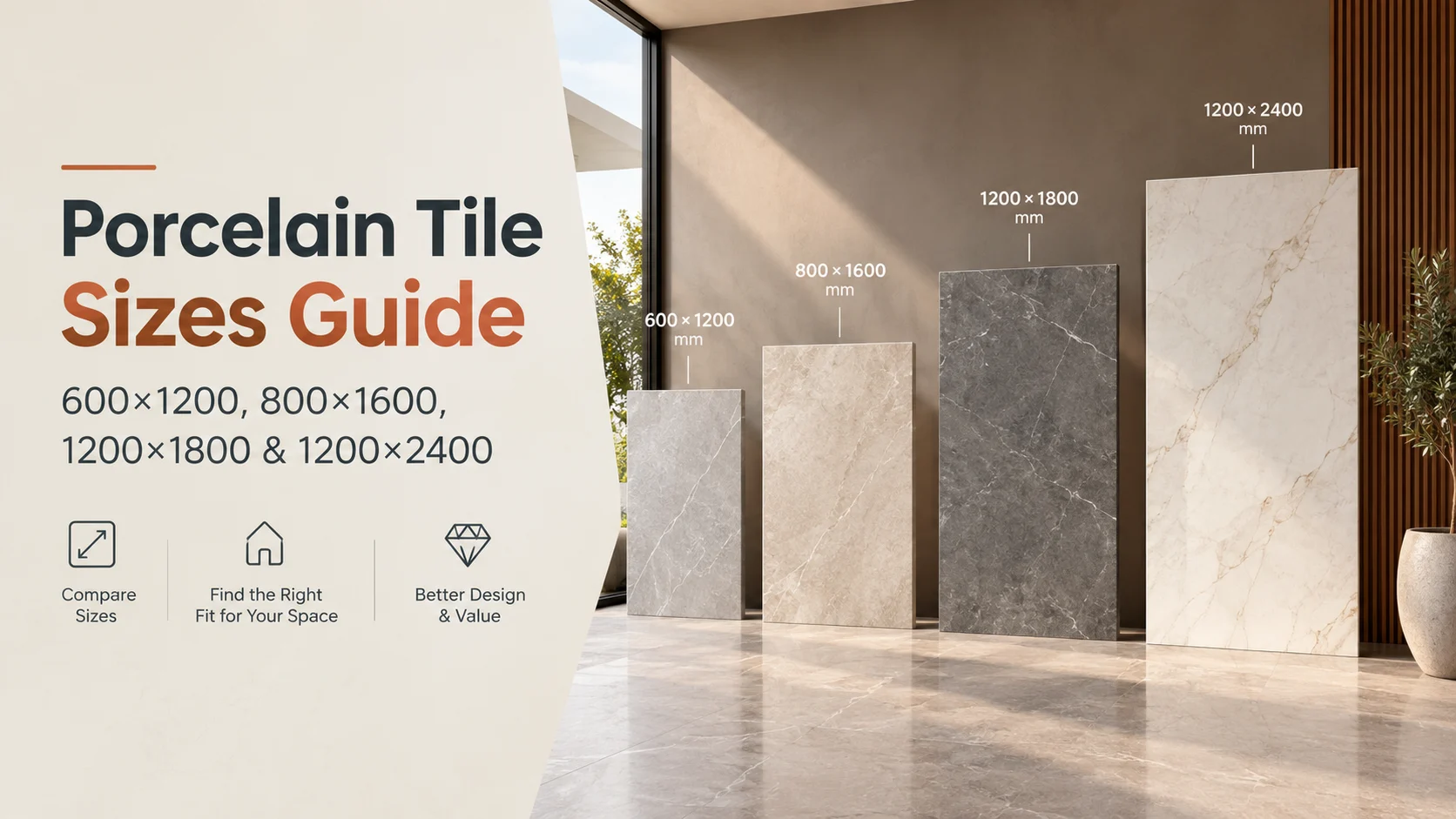
- Slab / large-format tile: any tile exceeding roughly 600×600mm, with true "slabs" typically starting around 1200×1800mm and extending to 1600×3200mm or beyond
How to Choose a Tile Manufacturer or Supplier for Your Project
If you've read this far because you're actually sourcing tile, not just researching the industry, a few practical filters matter more than brand recognition alone:
- Match manufacturer scale to your order size. A 300-million-sqm producer like Mohawk isn't necessarily the right fit for a mid-sized boutique hotel order; smaller, specialized manufacturers often provide more responsive service and design flexibility for orders that would be a rounding error to a global giant.
- Check export documentation experience, not just production capacity, ISO/CE certification, container-load packaging standards, and a dedicated export contact matter enormously for international orders.
- Ask about current lead times, since large-format slab production in particular has longer, less flexible production runs than standard tile sizes.
- Request real technical datasheets, not marketing brochures. Thickness, water absorption, and slip-rating figures should be available on request from any manufacturer serious about export.
- Consider India's emerging manufacturers alongside the established global names. With Morbi, Gujarat, now the world's second-largest ceramic cluster, manufacturers like Antovia Surfaces offer direct-from-source porcelain tiles and slabs across the 600×1200mm through 1600×3200mm range, often at more competitive pricing than established European or American brands, without sacrificing the certification and export infrastructure larger buyers require.
Frequently Asked Questions
Which company is the largest tile manufacturer in the world?
Mohawk Industries, through its Global Ceramics division, is the world's largest tile manufacturer by both production volume (over 300 million sqm annually) and revenue (USD 4.2 billion in 2024).
Is Kajaria Ceramics among the top tile companies globally?
Yes. Kajaria Ceramics is India's largest tile manufacturer and is one of only three Indian producers confirmed in current global industry rankings, with over 70 million square metres of annual production capacity.
Which countries dominate global tile manufacturing?
China leads by sheer production volume through groups like Marco Polo, Dongpeng, and Monalisa, while the USA (Mohawk), Mexico (Lamosa), and India (Kajaria, Somany, H&R Johnson) also feature multiple companies among the world's largest producers.
How is "top tile company" actually measured, by revenue or production volume?
It varies by source, and that's exactly why rankings differ so much. Ceramic World Review's methodology, used in this article, combines verified production volume with disclosed revenue where available, since not every company publishes comparable financial data.
Are there reliable Indian tile manufacturers for international sourcing outside this top 10?
Yes, India's tile export sector extends well beyond its three globally-ranked giants. Morbi, Gujarat, accounts for roughly 70% of India's tile output and hosts hundreds of manufacturers, including Antovia Surfaces, which produces and exports porcelain tiles and slabs across standard and large formats.
What's the difference between a "tile company" ranking by revenue and one by production volume?
Revenue rankings favor companies selling higher-value, design-premium products even at lower volumes, while production-volume rankings favor manufacturers optimized for scale and cost efficiency. which is why a company like Mohawk can lead both, while others rank very differently depending on which metric is used.
Why do Chinese tile manufacturers rarely appear in Western "top 10" lists despite massive production volume?
Largely a data-transparency issue rather than a scale issue, many major Chinese groups don't publish revenue or production figures in formats directly comparable to publicly listed Western companies, which is why sources like Ceramic World Review explicitly flag their rankings as non-exhaustive.
Is Mohawk Industries actually a "tile company," or primarily a flooring conglomerate?
Both, functionally. Mohawk's Global Ceramics division alone outproduces every dedicated tile-only manufacturer on this list, even though the parent company's broader portfolio spans carpet, vinyl, laminate, and wood flooring as well.
Final Thoughts
Rankings like this one shift constantly; acquisitions, capacity expansions, and currency swings all move the numbers year to year, which is exactly why relying on a years-old, unsourced list can leave you working from outdated information. The companies above represent the current, verifiable leaders of the global tile industry based on 2024–2025 data, not a static list copied forward since 2021.
If you're sourcing porcelain tiles or large-format slabs directly from India's manufacturing hub, Antovia Surfaces manufactures and exports across the 600×1200mm through 1600×3200mm size range from Morbi, Gujarat. Visit antoviasurfaces.com for current specifications and export pricing.