 11 Oct, 2026
29Views
11 Oct, 2026
29Views A flat wall can disappear into a room. A dimensional wall can change the room around it.
That is the appeal of 3D tiles. Their raised, recessed or carved surfaces interact with light to create depth that paint and flat patterns simply cannot reproduce. But choosing a dimensional surface is not as straightforward as finding a pattern you like. The relief, scale, finish, colour, lighting and location can completely change the final effect.
If you are comparing different tile surfaces for a project, it helps to first understand how different tile collections and finishes behave together. From there, the smarter question is not “Which design looks impressive?” but “Which surface will look right on this particular wall?”
What Are 3D Tiles and Why Do They Look Different?
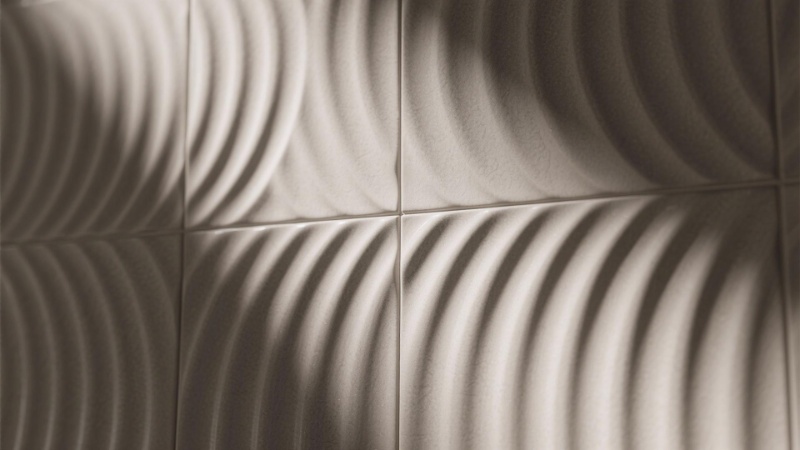
3D tiles are tiles with a physical surface profile rather than a completely flat face. The design may be raised, recessed, carved, fluted, geometric or curved. When light reaches those different levels, it produces highlights on the higher points and shadows inside the lower areas.
That physical depth is what separates a genuine dimensional surface from a flat tile with a printed pattern. A printed geometric design can look largely consistent throughout the day. A sculpted surface changes as the sun moves, lamps switch on and viewing angles change.
This also explains why a tile that looks subtle in a showroom photograph can become dramatic once installed. The wall is no longer just displaying a pattern; it is creating its own light-and-shadow effect.
Insert image of a close-up 3D wall tile showing raised and recessed texture here.
3D Tiles Design: Start With the Room, Not the Catalogue
A common mistake is falling in love with a tile before deciding what the wall needs to do. Instead, begin with the interior style and the role of the surface.
A minimalist room usually benefits from shallow geometric or linear relief because the texture adds interest without disturbing the clean visual language. Softer wave forms can work beautifully where you want movement without sharp geometry. Deeper sculptural patterns are better when the wall is intentionally being treated as the room's main architectural feature.
The same principle applies to colour. A low-contrast pattern lets the physical texture create the visual interest, while strong colour differences make the pattern much more obvious. A successful 3D tile design therefore balances pattern, depth and colour rather than treating them as separate choices.
How to Choose 3D Tiles for Different Rooms
There is no single “best” wall for dimensional tile. The right location depends on what you want the surface to accomplish. A bedroom usually calls for calmer relief, while a living room or entrance can support stronger visual drama.
The most useful approach is to consider three things together: how close the wall will be viewed, how much furniture will sit in front of it, and how much light will reach it. A wall seen from across a large living room can handle a larger pattern than a compact bedroom wall viewed from only a few steps away.
That is why 3D wall tiles should be selected according to application rather than trend alone.
3D Tiles for Bedroom Walls
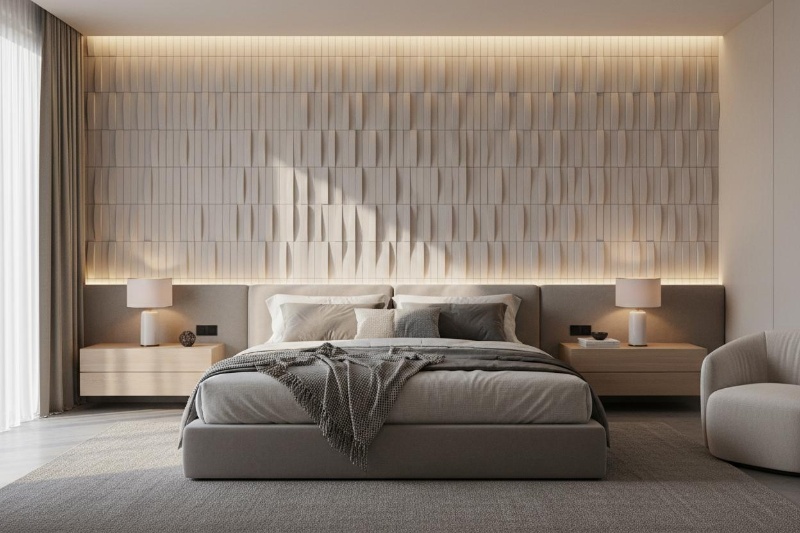
Bedrooms are naturally suited to controlled texture because the headboard wall already acts as a focal point. 3D tiles for bedroom applications can create an architectural backdrop without adding artwork, heavy colour or excessive decoration.
Shallow waves, soft fluting and restrained geometric designs generally create a calmer effect than deep angular patterns. Warm bedside lighting can emphasise the relief, so it is worth checking how the surface behaves under the actual lighting you plan to use.
For 3D tiles for bedroom wall applications, the headboard wall is usually the logical starting point. You can treat the complete wall as one surface or create a defined panel around the bed, depending on the room's proportions and furniture layout.
Insert image of a modern bedroom with a subtle 3D headboard wall here.
3D Tiles for Living Room Walls
The living room gives you more room to experiment. 3D tiles for living room applications can sit behind the television, sofa or another architectural focal point, creating depth without requiring a large collection of decorative accessories.
Large rooms can generally accommodate stronger patterns because the texture has more visual space around it. In a smaller living room, a controlled pattern or partial feature treatment may be more effective than covering an entire wall.
The goal is balance. If the sofa, curtains, artwork and flooring already have strong patterns, the wall should probably become quieter. If the rest of the room is restrained, the wall can take on more visual responsibility.
3D Tiles for TV Walls
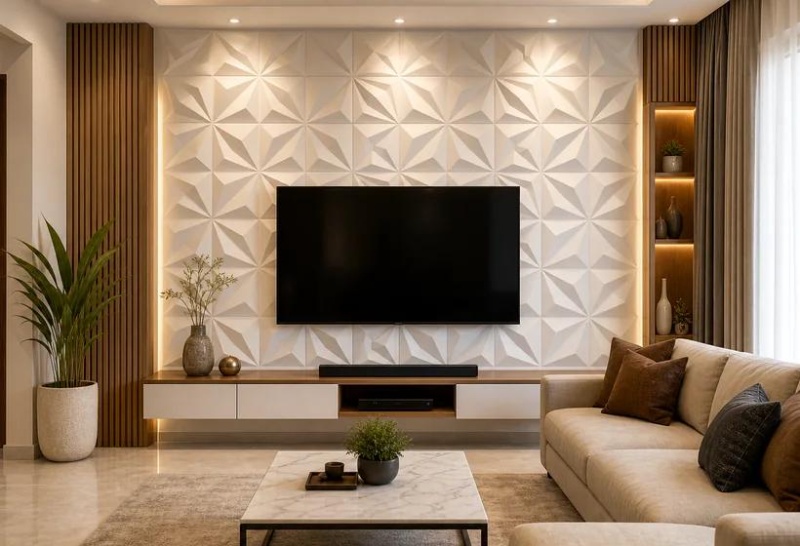
The TV wall deserves its own decision because the screen is already a powerful visual element. 3D tiles for TV wall applications work best when the texture supports the television rather than competing with it.
Very busy relief patterns can create unnecessary visual noise around the screen. A medium-scale geometric, fluted or wave texture can provide depth while keeping the television visually dominant.
Lighting matters here too. Avoid creating strong reflections or aggressive shadows directly behind the screen unless that effect is deliberately part of the design. The best TV backdrop usually looks interesting when the television is switched off without making the screen difficult to watch when it is on.
3D Tiles for Hall and Entry Walls
Entry areas are different. They are transitional spaces, so a stronger pattern can make sense here. 3D tiles for hall applications can give an entrance an immediate sense of character, particularly where the rest of the space is relatively simple.
In a narrow hallway, the direction and scale of the pattern can influence how the wall is perceived. Vertical relief can emphasise height, while a broad horizontal rhythm can create a different sense of proportion.
For 3D tiles for hall wall applications, however, resist the temptation to tile every visible surface. One well-positioned feature wall often feels more deliberate than a hallway where every wall competes for attention.
3D Tiles for Feature Walls: Make the Texture Earn Its Place
A feature wall should have a clear purpose. It might frame a television, define the headboard area, establish an entrance focal point or create a backdrop for a dining space.
That is why 3D tiles for feature wall applications are most successful when the texture relates to something else in the room. The wall should frame, support or define an architectural element rather than simply exist because there was an empty surface available.
A restrained relief can often create more sophistication than an extremely dramatic one. Texture does not need to shout to be noticed.
Insert image of a contemporary feature wall where 3D texture frames a TV or architectural niche here.
How Much Relief Depth Is Right for Your Space?
Depth is one of the decisions that gets overlooked most often. People compare patterns and colours, but the physical depth of the relief can have an equally strong effect on the room.
A shallow surface introduces texture without dominating the interior. Medium relief produces more visible shadow and becomes a stronger focal point. Deep relief creates a sculptural effect but also demands more attention from the rest of the room.
|
Relief depth |
Visual effect |
Where it can work well |
|
Shallow |
Subtle texture and soft shadows |
Bedrooms, minimalist spaces |
|
Medium |
Noticeable depth and stronger definition |
Living rooms, TV walls, dining areas |
|
Deep |
Dramatic sculptural appearance |
Large feature walls, statement interiors |
The easiest way to judge depth is to view a sample from both close range and normal room distance. If you only like the tile when your face is 30 centimetres away from it, the finished wall may not have the effect you expect. Conversely, if the pattern dominates the entire room from several metres away, it may be doing too much.
Glossy, Matt or Textured Finish?
The finish determines how strongly light interacts with the relief. Glossy surfaces reflect more light and can create bright highlights across raised areas. That can make a dimensional wall feel lively and polished, but it can also increase reflections.
Matt surfaces tend to create quieter transitions between light and shadow. They can be particularly effective when the relief itself is already strong. Textured or carved finishes push the tactile character further and can make the wall feel more architectural.
The important point is that finish and relief should be evaluated together. A deep sculpted pattern with a highly reflective surface will behave very differently from a shallow pattern in a matt finish, even if the colour is identical.
How Lighting Changes 3D Wall Tile Designs
Lighting is not an afterthought when selecting dimensional surfaces. It is part of the design.
Light coming straight toward the wall tends to flatten the appearance somewhat. Light arriving from the side produces stronger shadows and reveals more of the relief. Grazing light can make individual ridges, grooves and recessed sections dramatically visible.
Natural daylight adds another layer because its direction changes during the day. A wall facing a large window may look soft in the morning and much more contrast-heavy later. Artificial lighting can either exaggerate or soften this effect depending on its position.
Before finalising 3D wall tile designs, therefore, consider where the light comes from rather than judging a sample only under showroom lighting.
Choosing Colour and Pattern Without Overloading the Room
Colour changes the perceived intensity of texture. Light neutral surfaces often create a softer dimensional effect because the shadows provide much of the contrast. Darker colours can make relief feel stronger and more dramatic.
Pattern scale matters just as much. Small repeated shapes can produce a dense visual texture, while larger geometric forms tend to read more clearly across a broad wall. Neither is automatically better.
Think about what already exists in the room. If the flooring has strong veining, the furniture has patterned upholstery and the curtains are visually prominent, adding an extremely busy wall may create competition. When the rest of the room is quiet, the wall can carry more personality.
The best 3D tiles design ideas are therefore not necessarily the most elaborate ones. They are the designs that create the right amount of contrast for the room around them.
How to Use 3D Tiles Pictures Without Being Misled
Searching for 3D tiles pictures is a useful starting point, but an online image cannot guarantee how a product will look in your room. Photography changes the apparent scale, colour and depth of a surface.
A close-up photograph can make shallow relief appear dramatic. A wide-angle interior photograph can make a large pattern appear smaller than it really is. Lighting and post-processing can also change the apparent finish.
Use 3D tiles images for inspiration, then move to physical samples before making a final decision. Place the sample beside your flooring, cabinetry and furniture. Look at it during daylight and under artificial light. Then step back and judge it from the distance at which you will actually see the wall.
That simple process can reveal more than another hour of scrolling through inspiration images.
Installation and Maintenance: The Practical Side of 3D Tiles
The visual design is only half the job. A textured wall also needs proper preparation and installation. Uneven substrates, poorly planned cuts or misaligned repeating patterns can become much more obvious when the surface contains strong relief.
Plan the layout around corners, switches, sockets, doors, niches and other interruptions before installation. Pattern continuity can be particularly important with geometric designs.
Maintenance should also influence selection. Deep recesses can collect more dust than relatively shallow surfaces, while textured areas exposed to moisture or splashes may require more attention during cleaning. Product-specific installation and maintenance instructions should always take priority because not every tile has the same technical characteristics.
Common Mistakes When Choosing 3D Tiles
The first mistake is choosing from a close-up image instead of considering the complete wall. The second is ignoring lighting until the installation is finished. Because relief depends on shadows, lighting can completely change the character of the surface.
Another common mistake is matching the strongest possible pattern with an already busy interior. More texture does not automatically mean more luxury. Sometimes the most sophisticated wall is the one that gives the eye somewhere to rest.
Finally, consider maintenance before committing to a very deep profile. A dramatic surface may look fantastic on day one, but the practical experience matters just as much six months later.
A Simple Selection Framework
If you are still comparing options, work through the decision in this order: choose the wall, define its purpose, assess the room size, select the relief depth, consider the pattern scale, evaluate the finish, choose the colour, check the lighting and then review maintenance requirements.
After that, test a physical sample in the actual environment. This final step is important because a product can look perfect on a screen and completely different beside your real flooring, furniture and lighting.
The best 3D tiles are not necessarily the boldest or most expensive. They are the ones that make sense for the wall, the room and the way the space is experienced.
Frequently Asked Questions About 3D Tiles
Are 3D tiles suitable for bedroom walls?
Yes. They can work particularly well as a headboard-wall treatment. Softer wave, fluted and shallow geometric surfaces generally create a calmer appearance, while very deep patterns may produce stronger shadows under bedside lighting.
Can 3D tiles be used behind a TV?
Yes. A TV wall is a natural feature-wall application, but the pattern should be selected with the screen in mind. Medium-scale relief and controlled lighting can add depth without creating unnecessary visual distraction.
Do 3D tiles make a small room look smaller?
They can if the pattern is extremely busy, dark or deeply sculpted and is used across too many walls. A restrained design on one feature wall can instead add character without visually overwhelming the room.
Which finish is better for 3D wall tiles?
There is no single best finish. Glossy surfaces can emphasise highlights and create a brighter, more reflective effect, while matt finishes generally produce softer visual transitions. The right choice depends on the relief, lighting and interior style.
Are 3D tiles difficult to maintain?
Maintenance depends on the surface profile and the installation environment. Deeper relief can require more attention because dust may settle into recessed areas. Always follow the cleaning instructions supplied for the specific product.
How should I choose a 3D tile design?
Start with the wall and its purpose rather than the pattern. Consider room size, viewing distance, furniture, relief depth, lighting, finish, colour and maintenance. Then compare physical samples in the actual space before finalising the installation.
Conclusion
The best 3D tiles do more than decorate a wall. They use physical depth, light and shadow to create a surface that can change the character of an interior. The right selection depends on the room, wall position, pattern scale, relief depth, finish, colour and lighting—not simply on which catalogue image looks the most impressive. Whether you are planning a bedroom headboard, living-room feature, TV backdrop or entrance wall, the strongest result comes from matching the surface to the space.
Ready to explore options for your project? Browse the Antovia Surfaces e-catalogue to compare collections and surface styles, then contact the team to discuss the right tile direction for your application. A well-designed feature wall starts with a good-looking tile, but a genuinely successful one starts with choosing the right surface for the space.